Cart
Cart Products
Polystyrene Sonication Tubes Overview
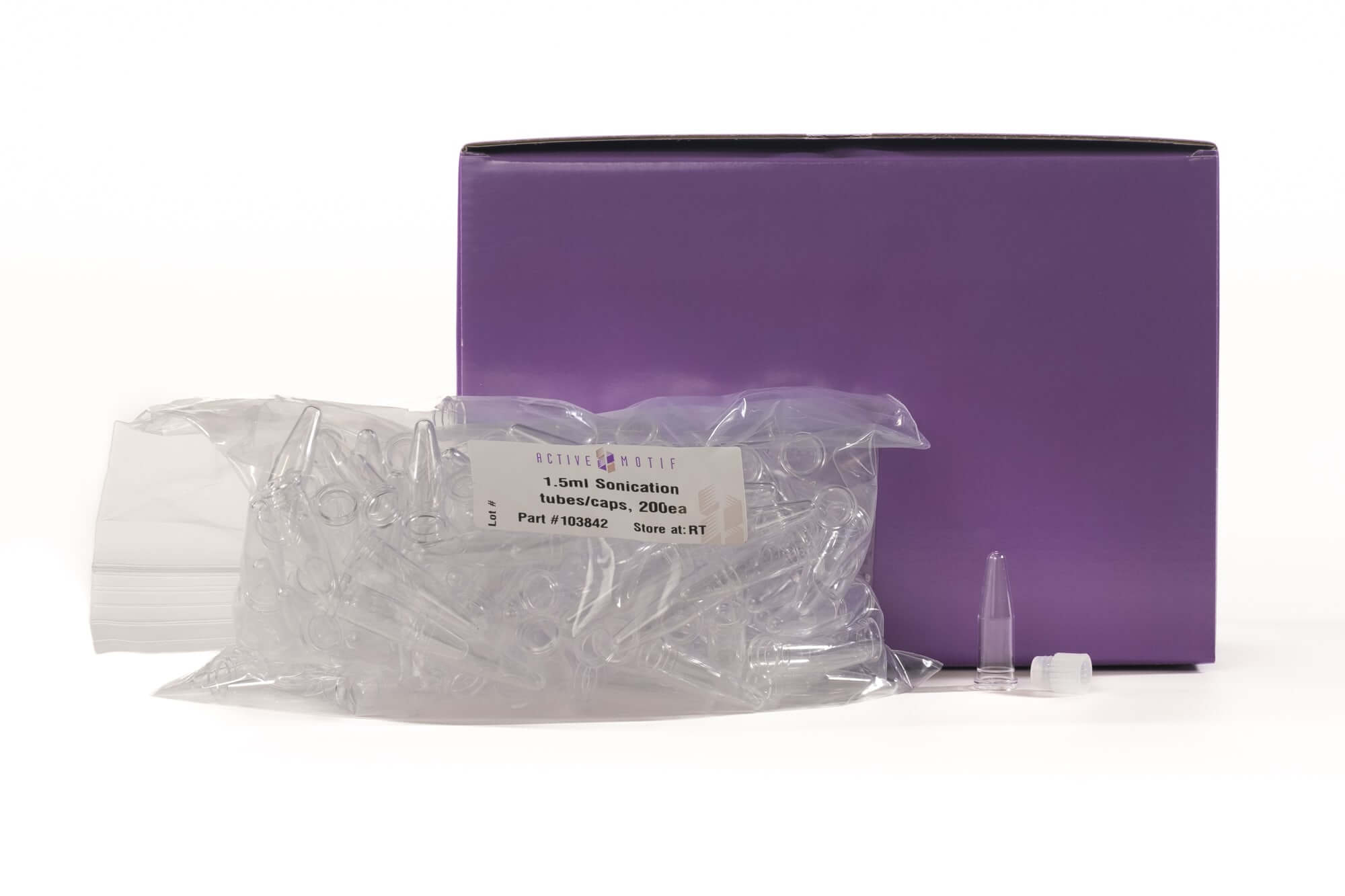
Because polystyrene transfers sonic wave energy much more efficiently than polypropylene, Active Motif highly recommends that its Polystyrene Sonication Tubes be used with multi-sample sonication. Use of polypropylene tubes in indirect sonication has been shown to reduce the extent to which the chromatin is sheared.
Tube Comparison
Improved shearing results using polystyrene tubes
A multi-sample sonicator was used to shear chromatin from 3T3 cell samples in both polystyrene and polypropylene tubes. Because cup horn sonicators use an indirect shearing method that requires the sonic wave energy to pass through the water bath and the wall of the tube, use of polystyrene tubes enables more efficient shearing, with far less high-molecular weight material remaining over after sonication (Figure 1). Therefore, Active Motif highly recommends use of its Polystyrene Sonication Tubes when performing indirect sonication using cup horrn sonicators.

Figure 1: Chromatin shearing in polystyrene versus polypropylene tubes.
Sheared chromatin was prepared from 20 µg per sample of 3T3 cells in a volume 250 µl using a cup horn sonicator at a 50% amplitude for 10 minutes. The samples were sheared in either Active Motif's Polystyrene Sonication Tubes (Lanes 2-3) or standard polypropylene tubes (Lanes 4-5). Gel analysis shows that, even though all samples were sonicated together, the chromatin prepared in the polystyrene tubes was sheared more completely. The samples prepared in polypropylene tubes have a much greater average length. A large percentage of the samples processed in polypropylene tubes remains at the top of the gel, as the shearing efficiency in polypropylene was relatively poor.
Polystyrene Sonication Tubes Contents
One or five bags containing 200 polystyrene sonication tubes (1.5 ml, non-sterile) and 200 polyethylene caps per bag.
Polystyrene Sonication Tubes Documents