Cart
Cart Products
This service is not available at this time.
Active Motif’s Targeted Next-Gen Bisulfite Sequencing Service offers significant advantages over the traditional Sanger-based method, most notably the ability to multiplex several amplicons from multiple bisulfite-converted DNA samples in a single Next-Gen sequencing reaction. Because 100X to 10,000X more data is generated for each cytosine, the resulting data is more statistically significant than Sanger sequencing. The service is an end-to-end assay and includes bisulfite conversion, primer design and testing, PCR amplification, library preparation, DNA sequencing and data analysis.
What our customers are saying about us:
"We used next-generation bisulfite sequencing and ChIP-Seq services to describe tumor suppressor function of KLF4 in pediatric leukemias. The quality of this service including the bioinformatic analysis was outstanding and essential for our project."
Daniel Lacorazza, PhD
Baylor College of Medicine
View complete list of testimonials >
Advantages of Targeted Next-Gen Bisulfite Sequencing
- More sequencing data results in greater statistical significance
- Use longer amplicons than Sanger Bisulfite Sequencing
- A more cost effective option for large-scale experiments using multiple cell types and/or amplicons
Sample Submission Portal
Our online sample submission portal allows you to easily upload your service project samples and track your project status. Follow the sample submission instructions in the portal to ensure that all your samples arrive at Active Motif in the best possible condition and properly associated with your project.
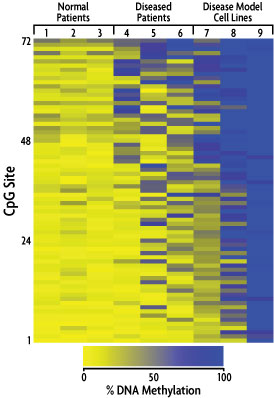
Figure 1: Heat map of Targeted Next-Gen Bisulfite Sequencing data.
MethylCollector Ultra-Seq was performed on 3 samples of interest to identify differentially methylated regions. One identified region was used for Targeted Next-Gen Bisulfite Sequencing on a broader population of 9 samples. This heat map shows the single base pair resolution of the 72 CpGs in this region across the 9 samples.
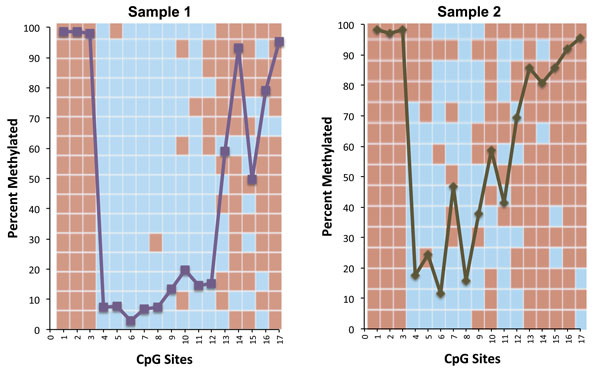
Figure 2: Comparison of Sanger and Targeted Next-Gen Bisulfite Sequencing data.
DNA from two different cell lines was bisulfite converted using Active Motif’s MethylDetector™ Bisulfite Modification Kit. Bisulfite sequencing primers were designed to amplify a 312 bp amplicon containing 17 CpG dinucleotides. For Sanger sequencing, the amplicons were cloned and 16 colonies from each sample were sequenced. Methylated CpGs are depicted as red boxes and unmethylated CpGs are depicted as blue boxes. For Targeted Next-Gen Bisulfite Sequencing, amplicons were sequenced directly resulting in over 10,000X coverage. The points in the line graph represent the percent methylation detected at each CpG. Quantitative differences in methylation are detectable between the two samples at CpGs 4 through 16.
| Active Motif Epigenetic Services Brochure |
| Products and Services to Study DNA Methylation |
| Sample Preparation for DNA Methylation Services |
| Epigenetic Services Citations |