Cart
Cart Products
Recombinant PHD1 (EGLN2) protein
| Catalog No: 81064 | Format: 20 µg | $520 | Add to Cart |
| Catalog No: 81764 | Format: 1 mg | $4,150 | Add to Cart |
Request a quote for a bulk order Request Quote
Expressed In: Baculovirus Protein Species: Human
Contents
A representative Technical Data Sheet (TDS) is provided here. Please refer to the lot-specific TDS you will receive with your order for the lot-specific buffer contents and protein concentration.
Background
Prolyl Hydroxylase Domain-Containing Protein 1 (PHD1), also known as Egl-9 Family Hypoxia-Inducible Factor 2 (EGLN2), HIF-PH1, or EIT6, is a member of the prolyl hydroxylase domain (PHD) family of oxygen-sensing enzymes. PHD1 catalyzes the post-translational hydroxylation of specific proline residues on hypoxia-inducible factor (HIF)-α proteins under normoxic conditions. It hydroxylates proline residues within the oxygen-dependent degradation (ODD) domains, including the N-terminal (NODD) and C-terminal (CODD) ODD domains of HIF-1α and HIF-2α, with a preference for the CODD site in both substrates. Hydroxylation of HIF-α proteins promotes their recognition by the von Hippel–Lindau (VHL) E3 ubiquitin ligase complex, leading to ubiquitination and subsequent proteasomal degradation. Under hypoxic conditions, PHD1 activity is reduced due to limited oxygen availability, allowing HIF-α proteins to escape degradation, translocate to the nucleus, heterodimerize with HIF-1β (ARNT), and activate the transcription of hypoxia-responsive genes. Beyond its role in HIF regulation, PHD1 participates in several HIF-independent cellular processes. It contributes to the regulation of hypoxia tolerance and apoptosis in cardiac and skeletal muscle and influences neuronal susceptibility to oxidative stress under normoxic conditions. PHD1 also links oxygen sensing to cell-cycle progression and primary cilium formation by hydroxylating the centrosomal protein CEP192, thereby promoting its ubiquitination and proteasomal degradation. In addition, PHD1 can hydroxylate inhibitor of nuclear factor kappa-B kinase subunit beta (IKBKB/IKKβ), contributing to the regulation of NF-κB signaling during hypoxia. Like other PHD family members, PHD1 preferentially recognizes substrates containing the conserved LXXLAP motif.
Application Notes
This protein is suitable for use in binding assays, inhibitor screening, and selectivity profiling.
Assay Conditions: 3 µM HIF1A (HIF-1α) peptide (DLDLEALAPYIPADDDFQL) was incubated with 300 nM PHD1 protein in 30 µl reaction system containing 20 mM Tris-HCl pH 7.5, 5 mM KCl, 1.5 mM MgCl2, 1 mM DTT, 100 µM 2-oxoglutarate, 100 µM ascorbate and 50 µM (NH4)2Fe(SO4)2·6H2O for 2 hours at 30°C. MALDI-TOF was used for detection.
View publications that use Active Motif products & services here. Enter the product number(s) to see publications & applications that use this product.
Protein Details
Recombinant human PHD1 / EGLN2 protein was expressed in a baculovirus expression system as the full length protein (accession number NP_542770.2) with an N-terminal FLAG tag. The molecular weight of the protein is 44.9 kDa.

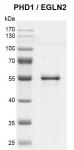
Recombinant PHD1 / EGLN2 protein gel
10% SDS-PAGE Coomassie staining
MW: 44.9 kDa
Purity: >90%
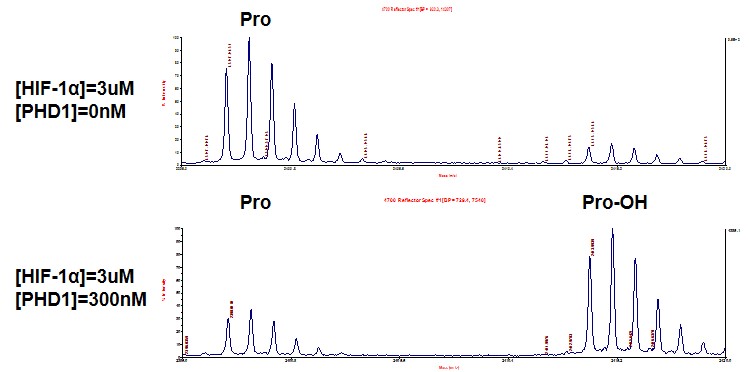
MALDI-TOF for Recombinant PHD1 / EGLN2 protein
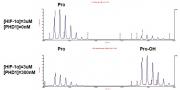
3 µM HIF1-α peptide was incubated with 300 nM PHD1 protein in 30 µl reaction system for 2 hours at 30°C. The reaction product was detected by MALDI-TOF. Single 3 µM HIF1-α peptide was used as a negative control.
Storage
Recombinant proteins in solution are temperature sensitive and must be stored at -80°C to prevent degradation. Avoid repeated freeze/thaw cycles and keep on ice when not in storage.
Guarantee
This product is for research use only and is not for use in diagnostic procedures. This product is guaranteed for 6 months from date of arrival.