Cart
 Products
Recombinant PIM2 protein
| Aliases: Pim-2 Proto-Oncogene, Serine/Threonine Kinase, Pim-2h |
| Catalog No: 81365 | Format: 10 µg | $480 | Add to Cart |
| Catalog No: 81665 | Format: 1 mg | $5,400 | Add to Cart |
Request a quote for a bulk order Request Quote
Expressed In: Baculovirus Protein Species: Human
Contents
A representative Technical Data Sheet (TDS) is provided here. Please refer to the lot-specific TDS you will receive with your order for the lot-specific buffer contents and protein concentration.
Background
PIM2 (Pim-2 Proto-Oncogene, Serine/Threonine Kinase) is a Protooncogene with serine/threonine kinase activity involved in cell survival and cell proliferation. Its oncogenic activity exerts through: the regulation of MYC transcriptional activity, the regulation of cell cycle progression, the regulation of cap-dependent protein translation and through survival signaling by phosphorylation of a pro-apoptotic protein, BAD. Phosphorylation of MYC leads to an increase of MYC protein stability and thereby an increase transcriptional activity. The stabilization of MYC exerted by PIM2 might explain partly the strong synergism between these 2 oncogenes in tumorigenesis. Pim2 regulates cap-dependent protein translation in a mammalian target of rapamycin complex 1 (mTORC1)-independent manner and in parallel to the PI3K-Akt pathway. It also mediates survival signaling through phosphorylation of BAD, which induces release of the antiapoptotic protein Bcl-X(L)/BCL2L1. PIM2 promotes cell survival in response to a variety of proliferative signals via positive regulation of the I-kappa-B kinase/NF-kappa-B cascade; this process requires phosphorylation of MAP3K8/COT. It promotes growth factor-independent proliferation by phosphorylation of cell cycle factors such as CDKN1A and CDKN1B and involved in the positive regulation of chondrocyte survival and autophagy in the epiphyseal growth plate. Diseases associated with PIM2 include Colorectal Adenocarcinoma and Lymphoma.
Application Notes
This product was manufactured as described in Protein Details. Where possible, Active Motif has developed functional or activity assays for recombinant proteins. Additional characterization such as enzyme kinetic activity assays, inhibitor screening or other biological activity assays may not have been performed for every product. All available data for a given product is shown on the lot-specific Technical Data Sheet.
Protein Details
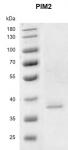
Recombinant PIM2 protein was expressed in baculovirus expression system as the full length protein (accession number NP_006866.2) with a N-terminal FLAG tag. The molecular weight of the protein is 35.5 kDa.
References
Human
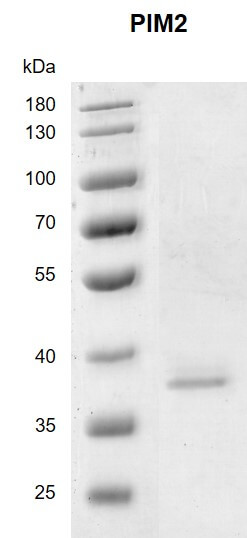
Recombinant PIM2 protein
10% SDS-PAGE with Coomassie staining
MW: 35.5 kDa
Purity: >95%

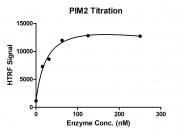
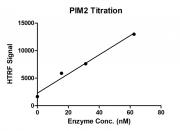
HTRF assay for PIM2 activity
1 µM STK S3 substrate was incubated with different concentrations of PIM2 protein in a 10 µl reaction system containing 1×Enzymatic Buffer, 5 mM MgCl2, 1 mM DTT and 100 µM ATP for 1 hour. The 10 µl detection reagents containing STK antibody (1:2) and SA-XL665 (1:100) diluted with 1× Detection Buffer were added and incubated with the reactions for 30 min. All the operations and reactions were performed at room temperature. HTRF assay was used for detection.
Storage
Recombinant proteins in solution are temperature sensitive and must be stored at -80°C to prevent degradation. Avoid repeated freeze/thaw cycles and keep on ice when not in storage.
Guarantee
This product is guaranteed for 6 months from date of arrival.