Cart
Cart Products
AbFlex® PHD1 (EGLN2) antibody (rAb)
| Aliases: prolyl-4-hydroxylase 1, Egl-9 Family Hypoxia Inducible Factor 2, HIF-PH1 |
| Catalog No: 91447 | Format: 100 µg | $400 | Add to Cart |
| Catalog No: 91448 | Format: 10 µg | $90 | Add to Cart |
Request a quote for a bulk order Request Quote
Product Review Submit a Review
Applications


Contents
A representative Technical Data Sheet (TDS) is provided here. Please refer to the lot-specific TDS you will receive with your order for the lot-specific buffer contents and antibody concentration.
Application Notes
Applications Validated by Active Motif:
WB: 0.1 - 0.5 µg/ml
IF: 0.4 - 2 µg/ml
Immunogen
This EGLN2 (PHD1) antibody was raised against a peptide of human EGLN2 (PHD1).
Buffer
Purified IgG in 140 mM Hepes, pH 7.5, 70 mM NaCl, 32 mM NaOAc, 40% glycerol and 0.035% sodium azide. Sodium azide is highly toxic.
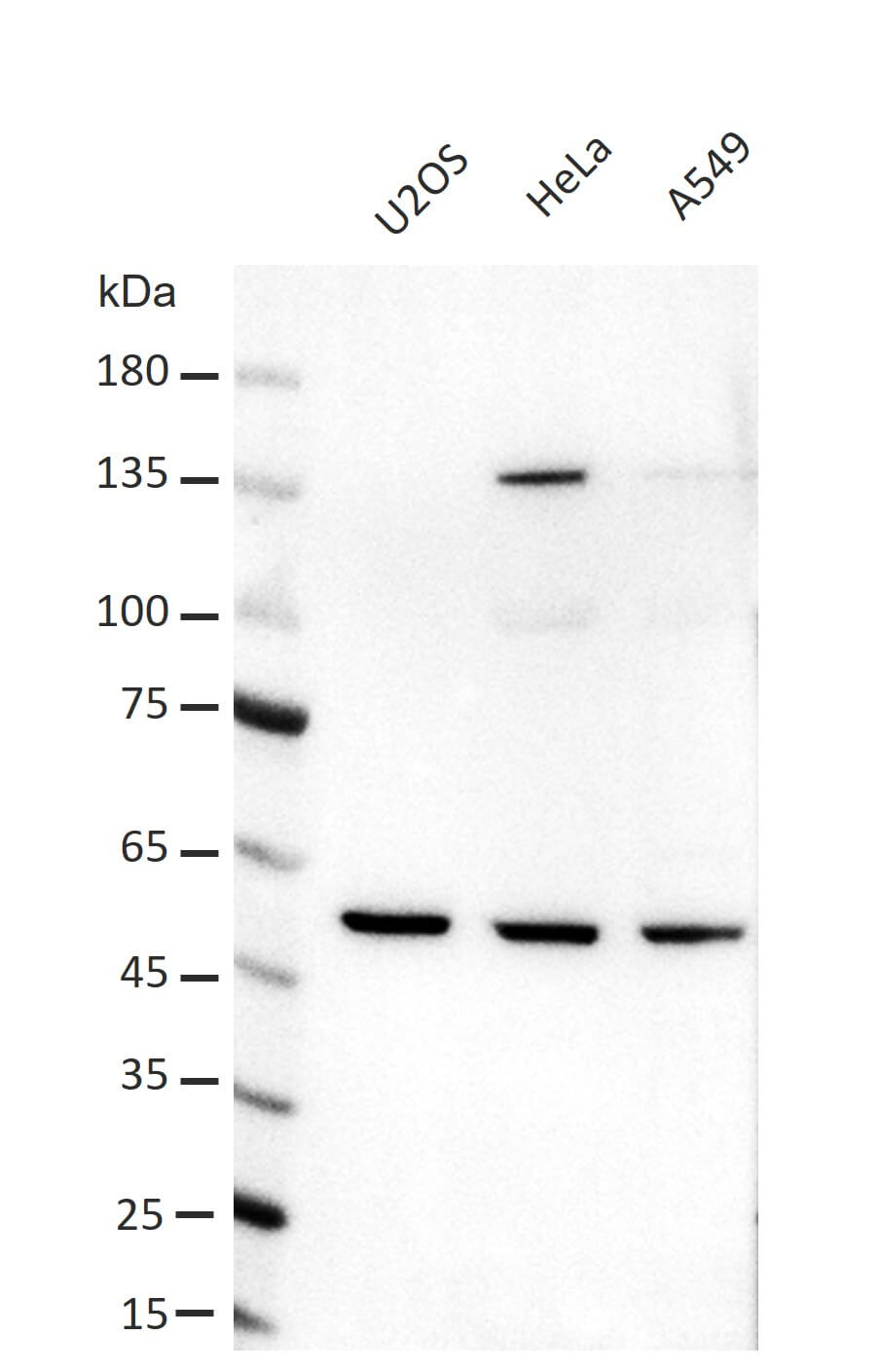
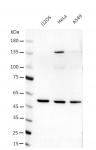
AbFlex® EGLN2 (PHD1) rAb antibody tested by Western blot.
U2OS, HeLa and A549 whole cell extracts (40 µg) were probed with AbFlex® EGLN2 (PHD1) antibody at 0.2 µg/mL.
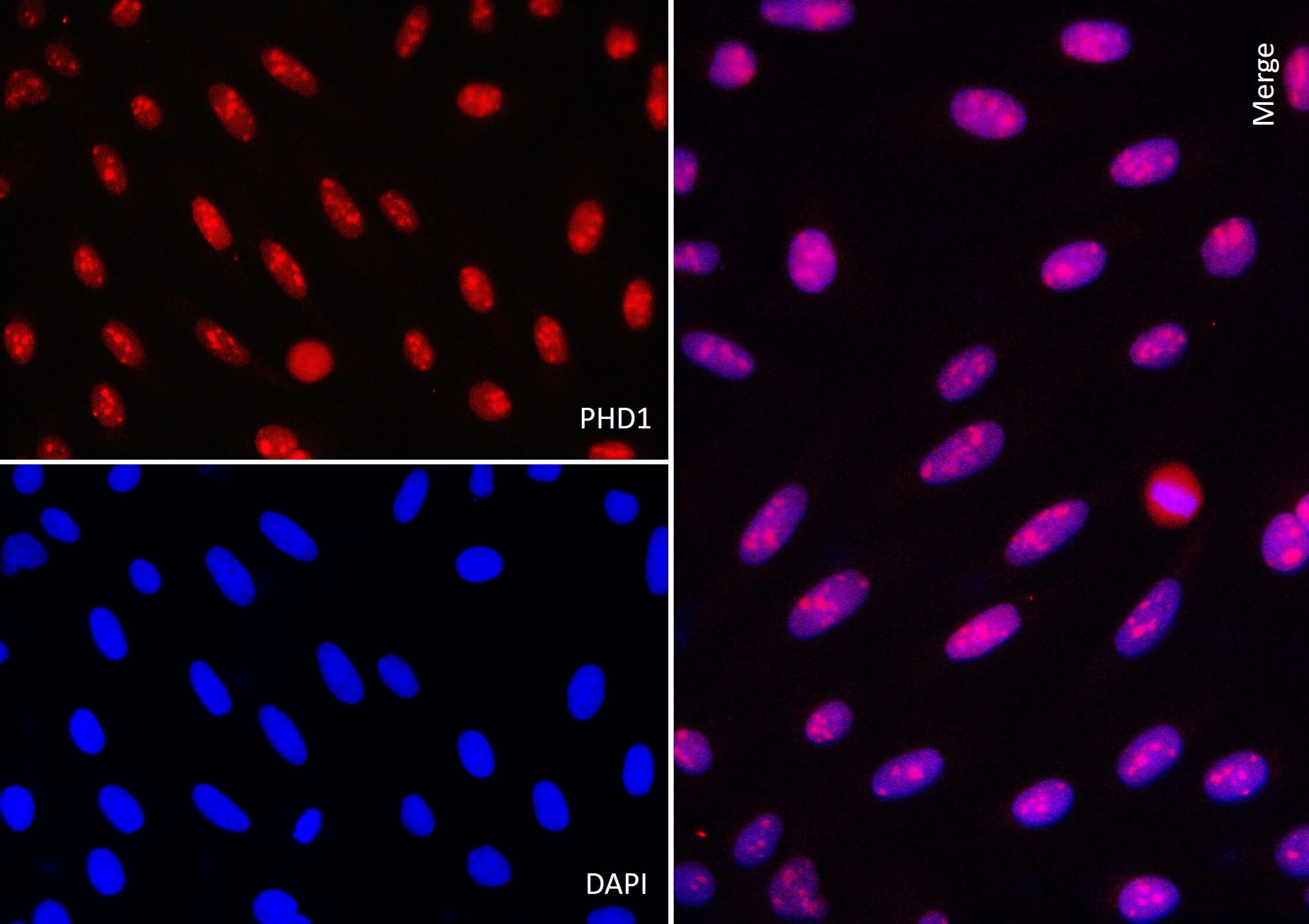
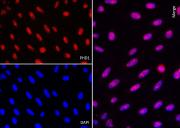
AbFlex® EGLN2 (PHD1) rAb antibody tested by immunofluorescence.
EGLN2 (PHD1) was detected in human U2OS cells using AbFlex® PHD1antibody (rAb) at 2 µg/mL, followed by Multi-rAb CoraLite® Plus 594-Goat Anti-Rabbit Recombinant Secondary Antibody (H+L).
Background
AbFlex® antibodies are recombinant antibodies (rAbs) that have been generated using defined DNA sequences to produce highly specific, reproducible antibodies. Each AbFlex antibody contains a 6xHis Tag, a Biotinylation Tag forenzymatic biotin conjugation using the biotin ligase, BirA, and a sortase recognition motif (LPXTG) to attach a variety of labels directly to the antibody including fluorophores, enzymatic substrates (HRP, AP), peptides, drugs as well as solid supports. AbFlex® EGLN2 (PHD1) antibody was expressed as full-length IgG with rabbit immunoglobulin heavy and light chains in mammalian HEK293 cells. Prolyl Hydroxylase Domain Containing Protein 1 (PHD1) or Egl-9 Family Hypoxia Inducible Factor 2 (EGLN2), also known as HIF-PH1 or EIT6, is a prolyl hydroxylase. PHD1 is a cellular oxygen sensor that catalyzes the post translational formation of 4-hydroxyproline in hypoxia-inducible factor (HIF) alpha proteins under normoxic conditions. It can hydroxylate a specific proline found in each of the oxygen-dependent degradation (ODD) domains (N-terminal, NODD, and C-terminal, CODD) of HIF1A, also HIF2A. PHD1 prefers the CODD site for both HIF1A and HIF2A.NODD, and C-terminal, CODD) of HIF1A, also HIF2A.
Storage
Some products may be shipped at room temperature. This will not affect their stability or performance. Avoid repeated freeze/thaw cycles by aliquoting items into single-use fractions for storage at -20°C for up to 2 years. Keep all reagents on ice when not in storage.
Guarantee
This product is guaranteed for 12 months from date of receipt.
This product is for research use only and is not for use in diagnostic procedures.
Application Key
- ChIP = Chromatin Immunoprecipitation;
- ChIP = ChIP Sequencing;
- CUT&RUN = Cleavage Under Targets and Release Using Nuclease;
- CUT&Tag = Cleavage Under Targets and Tagmentation;
- DB = Dot Blot;
- ELISA = Enzyme-linked Immunosorbent Assay;
- EMSA = Electrophoretic Mobility Shift Assay
- FC = Flow Cytometry;
- ICC = Immunocytochemistry;
- IF = Immunofluorescence;
- IHC = Immunohistochemistry;
- IP = Immunoprecipitation;
- MeDIP = Methyl-DNA Immunoprecipitation;
- NEU = Neutralizing;
- TIP-ChIP = Tagmented, Indexed, and Pooled Chromatin Immunoprecipitation;
- WB = Western Blotting